 English




Kenichi Ohno, Professor Emeritus
National Graduate Institute for Policy Studies
July 15, 2025
GKM is a consulting firm that develops and implements original methods for improving the performance of Vietnamese companies. Founded in Hanoi in 2015 by Dr. Nguyen Dang Minh, he studied engineering in Japan, earned a master’s degree from the University of Tokyo and a doctorate from Nagoya University, and worked in production management at Toyota’s headquarters in Aichi Prefecture. He then returned to Japan and founded this company. His distinctive style lies in his refusal to simply transplant the models he learned in Japan, but rather in his dedication to developing new coaching and training methods suited to the Vietnamese climate and culture, while also referencing Japan. He is a researcher and practitioner grounded in reality, and a talented industrial expert with a deep knowledge of Japan. I first met him in 2008, and have been following his methods and activities with interest ever since.
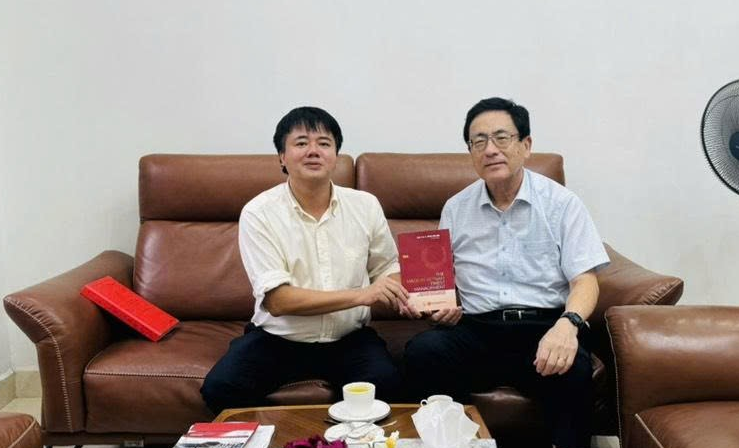
Mr. Minh runs his company with a grand design, working with his wife, Dr. Le Huong Giang, who also studied in Japan, his brother, Dr. Nguyen Dang Toan, and other members who share his practical theories. He holds CEO courses several times a year, teaching mindset and The Made in Vietnam Finest Management (The Made in Vietnam Finest Management) to business executives, and courses teaching child discipline at home to the general public. Some attendees have resonated with his ideas and have asked him to mentor their companies. In their consulting work, Minh and his team regularly visit individual companies, transforming their corporate cultures with new theories and achieving results. Meanwhile, Giang teaches 5S and Kaizen at home through home visits. He also has a program to reform educational methods. There seem to be many current activities and future plans and dreams, and they are constantly being revised and added, so I can’t keep track of them all.
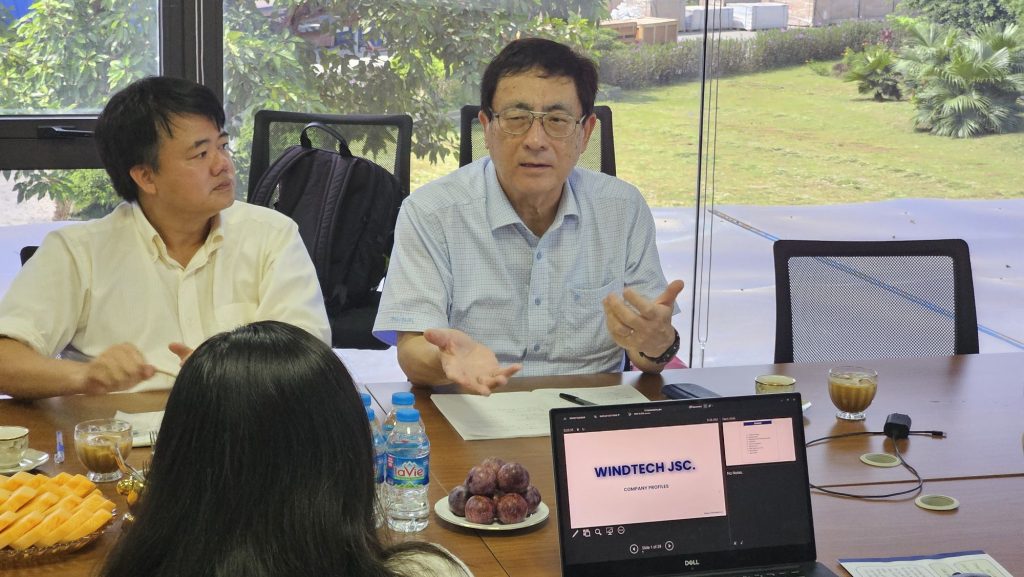
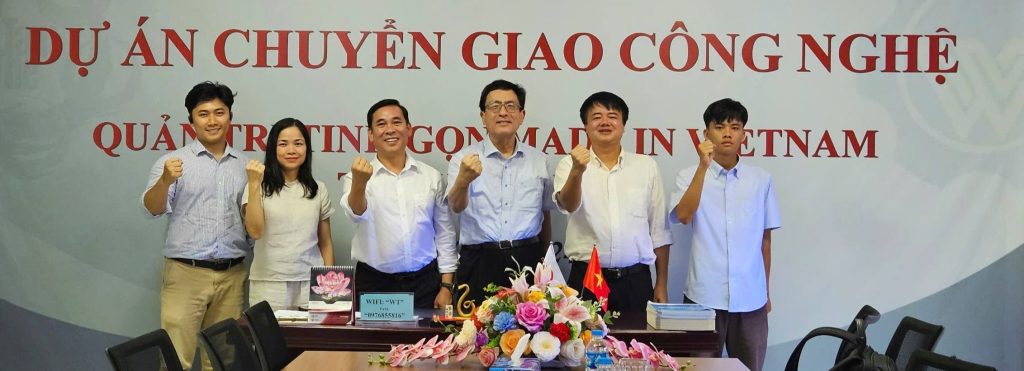
Professor Kenichi Ohno and Associate Professor Dr. Nguyen Dang Minh working with the leadership of Windtech Vietnam JSC (Photo: GKM)
GKM’s Methodology
I’ve listened to his explanations, read his books, and even visited his company for many years. While I understood the gist of his methodology, I never fully grasped the details. This was due to the fact that the details were confidential, he didn’t want to make it public during the trial-and-error process of developing the method, and I didn’t have the opportunity to closely observe his corporate training sessions. However, GKM celebrates its 10th anniversary this year, and the results of his corporate training have become clear. Minh told me that he now wants to make his methodology public. While his explanation isn’t entirely clear to me, I can summarise his methodology as follows:
First, Vietnamese people are different from Japanese people. Therefore, Vietnamese people need the right mindset (Tam The) to properly implement manufacturing. Without this mindset, introducing kaizen tools individually will be ineffective. Copying Japanese methods won’t work. It’s hard to fully understand how to teach this at a company unless you’re there, but from what I’ve heard, the process seems to be something like this: 1) Confirm the president’s commitment and get permission to implement GKM’s methods at the workplace (without this, they won’t start), 2) Gather all the company’s department managers and section chiefs together for repeated lectures and discussions on the methods, 3) Even if there are many opponents and skeptics at first, as the discussions continue, the majority will say, “If they insist, let’s give it a try,” and the remaining opponents are removed or demoted, 4) The department managers and section chiefs return to their respective departments and mobilize all employees to create standard operating procedures (SOPs) for each process. GKM provides guidance on this process, encouraging voluntary participation from employees.
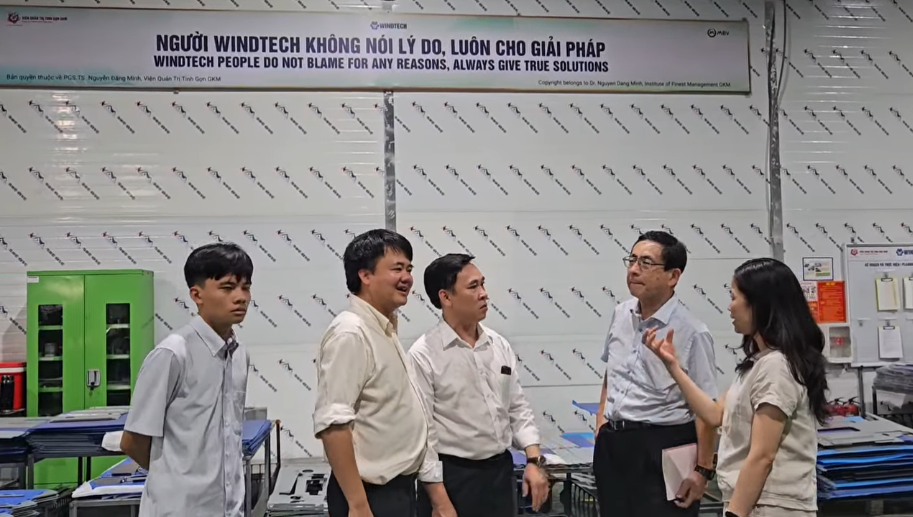
Professor Kenichi Ohno and Associate Professor Dr. Nguyen Dang Minh discuss with the leader at Windtech’s factory (Photo: GKM)
This is completely different from the way Japanese companies and JICA experts teach 5S and Kaizen. It seems Vietnamese people are well-suited to this approach, which involves the entire company and likely generates considerable friction and tension. It involves collectively changing people’s ways of thinking and behavior, not focusing on individuals or individual processes, but as a mass movement. Through this process, they learn to be the protagonists, to take pride in their work, to pursue efficiency by eliminating waste, and to realize that working together will improve the company. One of the teaching materials that Minh showed me included a contrasting image of people walking to one side on their way home from the factory, to avoid being a nuisance. In Japan, there’s no need to teach adults this.
Second, it’s people, not machines, that matter. While this argument is likely to be found outside of Vietnam, the people in this case refer to employees and their families. A company’s mission emphasizes the interests of employees, their families, the company, customers, and society. While the Omi merchants’ Sanpoyoshi philosophy simultaneously pursues the interests of the seller, the buyer, and society, the Gopoyoshi philosophy here prioritizes employees and their families. This is unique in that respect.
The background to this is the following fact: Vietnam has traditionally been a village society, where everyone participates in village festivals, collective work, weddings, funerals, and other ceremonies, and takes these things for granted. However, when workers come to work, they somehow become individualistic and self-centered. Minh argues that this cultural disconnect must be corrected and a sense of community similar to that of villages must be restored in companies. To achieve this, he says, it is important to first increase the unity, ambition, and profits of the people working at the company before considering the interests of the company, customers, and society. In Japan, there was once a trend toward thinking of the company as a family, but this mindset is no longer accepted by young Japanese people. However, in Vietnam, there seems to be ample room for reviving and strengthening a sense of community in companies.
Third, strengthen and implement SxQxCxDxE among all employees. S stands for safety, Q for quality, C for cost reduction, D for on-time delivery, and E for environment. Safety and QCD are self-explanatory. Here, E refers not only to environmental conservation but also to creating an environment that allows employees and their families to demonstrate their capabilities and feel satisfied. This also reflects the Vietnamese emphasis on employee happiness. GKM guides companies to maximize the product of these five elements and evaluates their achievements. The key here is that all employees must learn these five elements and put them into practice in their own positions. Separating production and quality control is not acceptable, nor is it acceptable to have separate responsibilities for safety and environmental measures. According to GKM, each employee must be a “manager” responsible for SxQxCxDxE. While high school graduates readily accept this approach, many university graduates, who tend to focus solely on their specialized fields, are unable to understand or accept it and end up quitting.
Even after GKM’s initial training program, each company continues to implement internal initiatives to maintain and strengthen these five elements. They recite Tam The and SxQxCxDxE at morning meetings in each department, set up study sessions, hold company-wide get-togethers, and invite employees’ families to learn new ways of thinking and behaving, which they then practice at home. GKM’s approach differs from the Japanese approach in that it focuses on employee motivation and inspiration rather than on on-site efficiency measures like 5S, kaizen, and QCC. While this mental aspect may emerge automatically in Japan or Korea, in Vietnam, it takes explicit steps to transform people’s minds. This likely reflects cultural differences. They have learned 5S and kaizen, and while their factories are reasonably clean, they don’t seem to be as particular about perfect organization and spotless toilets.
Fourth, based on the strengthening of Vietnamese companies, I propose a new “2.0 model” of bilateral industrial collaboration. This is primarily aimed at collaborations with Japanese companies, but it can also be applied to Vietnamese companies collaborating with companies in Korea, Taiwan, Europe, and the United States. In the previous collaboration (Version 1.0), Japanese companies brought their management, technology, and market knowledge to Vietnam and produced products using cheap, skilled local labor. While this collaboration is win-win in some ways, it often resulted in Japan, with its overwhelming knowledge and capabilities, acting as the teacher and Vietnam as the student. Simply adopting Japanese methods (management, technical guidance, contracts, employment, accounting, etc.) would not work. Therefore, Japan had to consider how to modify the Japanese model to improve the efficiency of its Vietnamese subsidiaries and partner companies. This was ultimately a Japanese task. Some Japanese companies succeeded, while others failed. GKM’s proposed bilateral industrial collaboration version 2.0 eliminates the hierarchical relationship of teacher and student, and instead involves both parties bringing their respective strengths to bear to co-create value. Specifically, Japan brings “production technology” and “market,” while Vietnam brings “management technology” and “employee training” (highly motivated and efficient local companies and their employees, improved through GKM’s methods). This collaboration is called MBV (Made by Vietnam) and MBJ (Made by Japan), and the combination of the two is called bilateral industrial collaboration version 2.0.
If this is realized, Japanese companies will no longer have to worry about how to train and guide local companies and employees. That is the Vietnamese side’s responsibility. GKM’s approach involves learning from the best aspects of Japan and cultivating a corporate culture that is compatible with it in a way that suits the Vietnamese people (collective orientation and communitarianism), ensuring compatibility with the Japanese model (5S, kaizen, QCD, long-term orientation, etc.). Furthermore, given the current weakening of the Japanese economy, this could serve as an important model for building new, more equal relationships with developing countries that Japan has previously provided aid to. It could also serve as a good example of translational adaptation, modifying the Japanese model to create a Vietnamese model.
Challenges for Expansion
Mindset reform, emphasis on employees and families, company-wide initiatives, company community building, promotion of SxQxCxDxE, and the 2.0 model of bilateral industrial collaboration all collectively have the potential to revolutionize the way Vietnamese companies operate and collaborate with foreign companies. This could also be one of the ways to achieve Vietnam’s dreams of breaking out of the middle-income trap, expanding added value along the smiling curve, and becoming a developed, high-income country (assuming GKM’s model is effective for Vietnam). The remaining challenges seem to be: (1) raising awareness of the effectiveness of this model among both the public and private sectors in both countries, (2) ensuring that many Vietnamese companies succeed in this transformation and increase the number of partners willing to collaborate with foreign companies, and (3) ensuring that Japanese companies (and other foreign companies) that understand this actually build 2.0 collaborations. In other words, in terms of the three steps of introducing a foreign model, the “learning” and “adaptation/internalization” stages have been completed, and now it is time to begin the “dissemination” stage (Tsuyoshi Kikuchi, “Considerations on ‘Intermediary’ Technology Transfer: Building and Applying a Three-Stage Model,” Doctoral Dissertation, Takushoku University, 2014).
To date, GKM has trained and improved the performance of approximately 1,000 Vietnamese companies across a variety of sectors. One of the largest and most well-known local companies is Truong Hai (Thaco), an automobile assembly company. In addition to producing its own brand of commercial vehicles, the company also contracts out the assembly of passenger and commercial vehicles from Mazda, Peugeot, BMW, Mitsubishi, and Kia. The company’s president and management highly value Minh’s guidance. Other well-known companies include VCC (a subsidiary of Viettel) and Petrolimex, though GKM’s involvement there has been short-term and partial. Other companies that GKM has supported through training and company visits include Le Group (metal parts), Manutronics (electronic components), Thieu Do (uniforms and suits), NCNetwork (a Japan-Vietnam business network), AVC Crane (factory cranes), Windtech (metal frames and components), AMECC (large equipment and buildings), and Bao Minh (confectionery). In addition, companies in a variety of sectors, including manufacturing, tourism, apparel, and healthcare, have likely come into contact with and learned from GKM’s methods. Dozens of CEO courses for corporate executives have already been held, and interest and influence continue to grow. Mitsubishi Corporation’s local president, Toru Funayama, also took an interest in GKM and participated in one of its courses. However, overall, this method is not yet well-known within the Japanese and Vietnamese industrial, government, and academic communities.
Japan’s productivity movement began in the late 1950s. Through the needs of many companies, support from capable industrial NPOs, and the dispatch of overseas missions and seminars after their return, it progressed through stages of learning, adaptation, internalization, and diffusion over a period of just over five years, achieving significant results at the national level. In contrast, GKM’s activities are purely private and independent, with a small budget and staff, and it has yet to receive official recognition or cooperation from public institutions or industrial NPOs.
Now celebrating its 10th anniversary and steadily building a track record, GKM plans to disclose its trade secrets and focus on promotional activities. The content of the project will likely overlap with what I have written in this memo. I understand that as part of the promotional activities, seminars will be held in Tokyo and Nagoya in October. As the promotion of the methodology and the success stories of client companies reinforce each other and expand, if it reaches a certain critical point, it could become a nationwide movement in Vietnam. However, for now, expansion requires issues such as public relations materials, promotional media, support organizations, and recognition by the Japanese and Vietnamese public and private sectors. First, we will need pamphlets, papers, reports, presentations, and websites that effectively explain the “trade secrets.”
We have looked at GKM’s efforts to improve Vietnamese companies, but Minh believes that Vietnam needs to improve three areas: businesses, households, and the government. While GKM has already begun the first two, there has been no clear entry point for government improvement. However, the Party and government, led by General Secretary Tra Lam, are currently implementing bold reforms. While administrative reforms have already been implemented, private sector development (PSD) has also been promoted as a pillar of the economic reforms. However, the specific methods for achieving this are unknown. It seems to me that Minh believes that the methodology developed by GKM can contribute to this, and intends to approach the party and government.
The end